
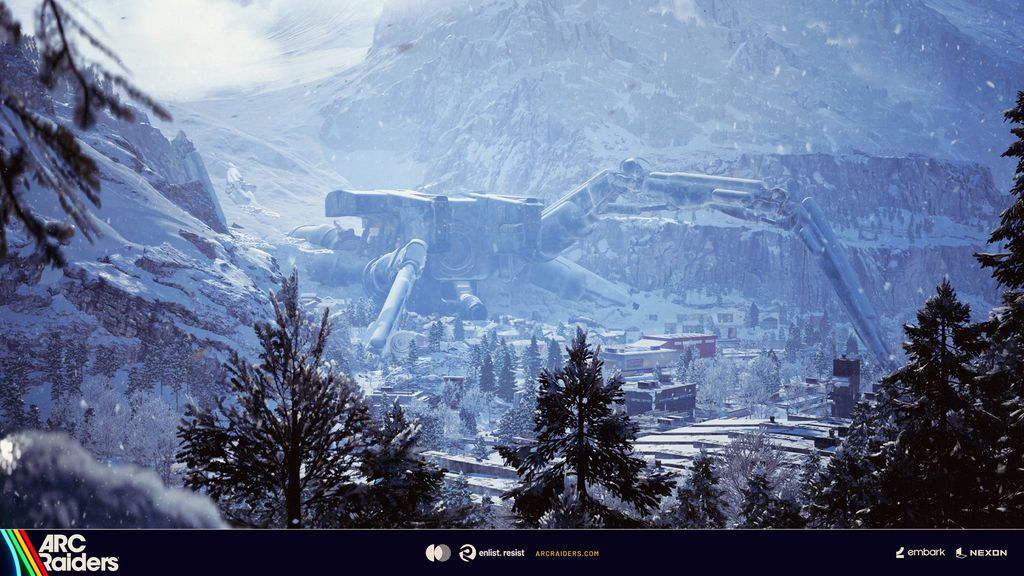
A new surface is not a new colour grade. Frozen Trail opened a snow-covered region with conifers and industrial ruins, and the material properties of that region change how a raid has to be played. The changes are not dramatic individually; together they invalidate several habits that were reliable on the older surfaces.
The 2.0 update also added new ARC units to the codex and extended the reward pass with a Frozen Trail track, and it was accompanied by a free-play window from 8 to 12 October. That last detail matters for anyone learning the surface now: free-play windows change the population, and a surface learned during and immediately after one is learned in unusually crowded conditions.
Snow opens sightlines in both directions
The most immediate change is visual. A snowfield gives a moving figure a hard silhouette against it, which means the raider who thinks they are crossing an empty expanse is often the most visible thing in it. On the older surfaces, terrain and vegetation broke up silhouettes at middle distance. On snow, the middle distance is where you are most legible.
The consequence is that route planning has to treat open ground as a cost rather than as a shortcut. A route that crosses a snowfield to save ninety seconds spends those ninety seconds being watched, and the watcher has no reason to reveal themselves until the crossing is committed. The correct habit is to plan crossings before the raid, at the points where terrain interrupts the field, rather than to improvise them on arrival.
Sound becomes less reliable
The second change is auditory, and it is subtler. Snow muffles footsteps unevenly, so sound stops being a consistent map. On a surface with hard ground, a footstep heard at a given volume implies a given distance. On snow, the same volume can mean a much shorter distance, because the surface absorbed part of it.
This has two effects that pull in opposite directions. The first is that distant sounds become less informative, so a raider who relied on “if I hear nothing, nothing is near” loses confidence in that inference. The second is that close sounds become more surprising, because the gradient that would normally warn you has been compressed. The practical response is to substitute sightlines for sound: on snow, look more, listen the same.
It also means a raider is quieter than they think. A crossing that would have been audible on hard ground may pass unheard on snow — which is an advantage, and one worth using deliberately rather than accidentally. The habit is to notice which surfaces are absorbing and which are not, and to move through the absorbing ones when proximity is unavoidable.
Ridges are decisions, not positions
Snow surfaces are built around elevation, and a ridge is the clearest example of a place that is both the best vantage and the worst cover. From a ridge you can see a great deal; from a ridge you can also be seen from a great deal. The sky above a ridge is the part that matters, because flying ARC units do not need line of sight to find a raider.
A unit overhead functions as a timer rather than as an enemy: it holds position, marks the location, and the ground units arrive on the mark. That makes a ridge dangerous in a specific way — holding one for the view is precisely the behaviour that gets a raider marked. The correct use of a ridge is to cross it, take the information available in the crossing, and descend on the far side rather than to settle on top.
What the snow changed about extraction
Extraction logic does not change, but the geometry around it does. With longer sightlines, an extraction point is visible from further away, which means the window during which a raider can approach unobserved is shorter. The 2.1.0 update fixed one specific unfair death — players could be eliminated despite being inside the Gondola and extracting — and that fix is a reminder of how much of extraction risk is geometric.
The practical adjustment is to arrive later and closer. On a surface with long sightlines, a long approach on foot is a long period of exposure, so the final approach should start as near to the extraction as the route allows. That in turn makes the penultimate waypoint more important than the extraction itself: the last piece of cover before the open is where the decision is actually made.
Routing in cold-weather terms
A route across a snow surface is best thought of as a series of covered segments joined by crossings, rather than as a line from A to B. Each crossing is a commitment, and the plan should specify where each one begins and ends. Three crossings planned in advance beat one crossing improvised, because an improvised crossing happens at the moment of least information — when you are already exposed and deciding.
The industrial ruins on the surface provide the covered segments, and they are worth learning as a network rather than as individual buildings. What matters is not what is inside a given ruin but which ruin connects to which, and where each connection emerges. That is the same lesson as on any surface, applied to a map where the gaps between cover are more expensive.
What transferred from the older surfaces
It is worth being clear about what did not change, because a new surface can create the impression that all prior knowledge is void. Preparation still determines the raid; weight is still a combat statistic; extraction is still a location rather than a state; and information still beats firepower.
What changed is the cost of the specific tactics that implement those principles. Crossing open ground got more expensive. Relying on sound alone got less reliable. Holding elevation for information got more dangerous. The principles are the same; the price list is different, and the price list is what a surface guide is actually for.